Cost, Income, and Sales Approaches in Commercial Property Appraisal for Cambridge, Ontario
Commercial valuation is both a discipline and a craft. You need a framework that lenders, courts, and investors respect, and you need the judgment that comes from working with the buildings, the leases, and the people who make a market. In Cambridge, Ontario, the three classical valuation approaches still anchor credible opinions of value, but the way they get applied depends on the asset, submarket, and purpose of the appraisal. An industrial condo off Pinebush Road is not a mixed‑use heritage conversion on Main Street in Galt, and both are different again from a national‑tenant pad on Hespeler Road. The right method, or the right blend of methods, depends on what is economically driving the property.
What follows is a practical tour through the cost, income, and sales approaches as they are used by seasoned commercial real estate appraisers in Cambridge and the surrounding Waterloo Region. The aim is to show how these methods work on the ground, where the pitfalls lie, and how a professional commercial appraiser in Cambridge, Ontario reconciles competing signals into a single, defensible number.
Why the three approaches still matter here
Cambridge is a tri‑community city with three distinct cores, linked by the Grand River and Highway 401. Industrial users value the 401 access and the labour pool. Retailers want visibility along Hespeler Road and steady traffic. Office demand has been more selective, with tenants preferring efficient floorplates and good parking while older stock competes on price. Multi‑residential is strong region‑wide, but commercial appraisal focuses on income‑producing non‑res assets and owner‑occupied facilities.
Because the built fabric ranges from pre‑war brick warehouses to tilt‑up distribution boxes to bespoke medical clinics, the three valuation approaches illuminate different truths:

- Sales comparison captures what the market is paying for similar assets right now, adjusting for differences.
- Income capitalization translates cash flow, risk, and growth into value, which is critical for most leased assets.
- Cost new less depreciation tests whether the market would reasonably pay more for an existing property than it would cost to build or replace it, and it is often the best anchor for special‑use or owner‑occupied buildings.
A credible commercial property appraisal in Cambridge, Ontario does not blindly average outcomes. It assigns weight where the evidence is strongest and where market participants actually think. For a leased strip plaza with stabilized tenants and few deferred capital items, the https://reidpwhw522.lucialpiazzale.com/industrial-valuation-tactics-from-commercial-building-appraisers-cambridge-ontario income approach usually leads. For a church, a cold‑storage facility with limited comparable leases, or a new owner‑occupied medical clinic, the cost approach often carries more weight.
Sales comparison in a market of small samples
The sales approach seems straightforward. You find comparable sales, adjust for differences, and derive an indicated value. In Cambridge, the challenge is seldom finding one or two comps, it is building a statistically meaningful set while maintaining similarity. Three anecdotes show how judgment matters.
A single‑tenant industrial sale near Boxwood Drive trades at a price that, on paper, looks low on a per‑square‑foot basis. Drill down and you learn the seller did a short‑term sale‑leaseback with a below‑market rent and a relocation clause. The buyer priced the risk, not just the building.
A mid‑block retail plaza on Franklin Boulevard sells in a private deal between related entities. The deed shows a number, but the consideration includes vendor take‑back financing at an attractive rate, which changes the economics.
A converted brick warehouse in Galt moves at a premium per foot compared to more generic stock. The buyer is a user who values brand and character. If you are valuing a plain‑vanilla flex property, you do not want that comp in your median without significant downward adjustment.
Good commercial real estate appraisers in Cambridge, Ontario pull from Cambridge, Kitchener, Waterloo, and occasionally Guelph or Brantford, then adjust for submarket differences tied to access, demographics, and tenant mix. Hespeler Road exposure commands a different retail rent and profile than a neighborhood strip in Hespeler village. Industrial users care whether trailer access is simple and whether the site offers expansion potential. When you see wide adjustments for time, remember that 2021 to 2022 cap rates and prices are not apples to post‑rate‑hike apples. Many 2021 sales still inform physical adjustment patterns, but you have to layer in the shift in cost of capital that rippled through 2023 to 2025.
Two techniques raise the quality of this approach:
First, normalize to price per square foot of gross leasable area for retail and industrial, and to price per square foot of net rentable area for office, then sanity check with land‑to‑building ratios and site coverage. If a comp shows 60 percent site coverage in a submarket where 35 to 45 percent is typical, it might be functionally superior for some users and inferior for others. That shows up in price.
Second, control for lease status. A fully leased small‑bay industrial property with staggered maturities is not the same as a vacant building. If the subject is leased at market, sales of similar stabilized assets are more persuasive than vacant sales, even if you have to adjust for remaining lease term. The reverse is true for owner‑occupied subjects.
In practice, a sales grid for a 20,000 square foot small‑bay industrial in Cambridge might draw five to eight comps from the past 12 to 24 months, with time adjustments where market data supports them. Industrial pricing ranges have been wide. Regionally, in 2024 to early 2025, stabilized small‑bay industrial has transacted from roughly 150 to 300 dollars per square foot depending on clear height, bay size, loading, age, and tenancy, with outliers both below and above. If you are at the high end, you likely have newish construction, 24 foot clear or better, efficient loading, and solid leases. If you are at the low end, expect older roofs, shallow bays, limited power, or a location trade‑off.
Income capitalization when cash flow is king
For most leased assets in Cambridge, the income approach deserves priority. Lenders underwrite debt service coverage against stabilized net operating income. Investors live by cap rates and yield on cost. The devil is in which income method fits: direct capitalization for stabilized assets, or a multi‑year discounted cash flow when lease‑up, step‑ups, or tenant improvements will materially change income trajectory.
Start by scrubbing the rent roll. Verify contract rents against market benchmarks, not just citywide averages but submarket and asset‑quality peers. A national QSR pad with a 10 year net lease on Hespeler Road is a different universe from a convenience store in a neighborhood strip. For industrial, look at small‑bay versus large‑bay, loading configuration, and clear height. Market rents across Waterloo Region have generally trended up over the past five years, but with some flattening in 2023 to 2025 as interest rates rose and tenants pushed back. Industrial rents often land in the low to mid‑teens per square foot net for older stock and mid‑ to high‑teens or low‑twenties for newer or specialized space. Inline retail has ranged widely from single digits in secondary locations to mid‑teens or higher in prime spots. Office has been bifurcated, with Class A suburban space achieving mid‑teens net and older B and C stock discounting or offering generous incentives. These are broad ranges, and a competent commercial appraiser in Cambridge, Ontario will anchor to transactions in the subject’s competitive set.
Vacancy and credit loss also demand local nuance. Industrial vacancy in Waterloo Region has sat at historically low levels for much of the past few years, even as new supply arrived, while office vacancy climbed. For many industrial and retail assets in Cambridge, a stabilized vacancy allowance in the 2 to 5 percent range has been common, though single‑tenant properties need a different treatment because downtime can be lumpy. For older office, effective vacancy and inducement costs can push the economic vacancy above the physical vacancy rate. This is where a simple direct cap can mislead, and a short DCF with explicit leasing costs does better.
Expenses split into recoverable and non‑recoverable categories. Most triple net leases pass through taxes, insurance, and base common area maintenance, but not every form of capital item is recoverable, and management fees and leasing costs typically sit with the landlord. In Cambridge, property taxes can be a swing factor, particularly for retail and office. Review assessment history and check whether a recent reassessment could change the expense line in the near term. If the subject is under‑assessed, your pro forma needs to reflect a normalized tax burden, not the current anomaly.
Cap rate selection draws the most scrutiny. The rate is a distillation of risk, growth expectations, and liquidity. A single‑tenant building with a near‑term rollover to an undifferentiated tenant will usually demand a yield premium compared to a multi‑tenant property with staggered expiries and diversified uses. Regional investors have been underwriting small‑bay industrial with cap rates that, at the peak of cheap money, compressed below 5 percent for the best assets, then moved out as rates rose. Through 2024 into 2025, you can see trades and offerings in the 6 to 7.5 percent range for a wide swath of stabilized industrial in secondary locations, with sharper pricing for prime product and wider for hairier situations. Retail cap rates have been remarkably asset specific. A grocery‑anchored center with long‑term covenants may still draw sub‑6 percent pricing, while a dated plaza with short terms may need 7.5 to 8.5 percent or more to clear. Office often sits higher, and sometimes much higher for Class B and C.
Sensitivity analysis helps. Move the cap rate 50 basis points and see if your indicated value still makes sense compared to recent sales per foot and to replacement cost. If the math says a 1970s industrial box with functional limitations is worth more than it would cost to build new, including soft costs and profit, you may be over‑estimating achievable rent, under‑counting downtime and capex, or mis‑setting the cap rate.
An example brings this home. A 30,000 square foot multi‑tenant industrial on a 2 acre site with 22 foot clear, a mix of drive‑in and dock loading, and average tenant size of 3,000 square feet, shows in‑place net rent averaging 14 dollars per square foot with terms remaining between two and four years. Stabilized vacancy at 3 percent, non‑recoverables at 3 percent of EGI, and management at 3 percent leave a net operating income around 390,000 dollars. Using a 6.75 percent cap indicates roughly 5.8 million dollars before adjustments for any near‑term capital. If your sales comps for similar assets cluster between 175 and 225 dollars per square foot, or 5.25 to 6.75 million, your income indication sits sensibly within the observed band.
The cost approach where bricks and budgets tell the story
The cost approach asks what it would cost to reproduce or replace the subject with equal utility, then reduces that number for all forms of depreciation, and adds land value. In Cambridge, I rely on this method most for special‑purpose or new owner‑occupied buildings, and as a check against inflated income assumptions.
Start with a clear scope. Replacement cost new is nearly always more relevant than reproduction cost for commercial work. For a tilt‑up industrial, that means a modern equivalent that delivers the same utility, not a line‑by‑line replica. Hard costs for light industrial in Southern Ontario in 2025 commonly fall in the 160 to 250 dollars per square foot range for simple boxes, climbing with higher clear heights, specialized MEP, or cold storage. Retail shell space often lands in the 220 to 350 dollars per square foot range, before tenant improvements. Medical office or lab can run higher still. Then add soft costs, frequently 20 to 30 percent of hard costs when you capture design, permits, development charges, contingencies, and financing. Developer profit needs to be in the model if you are simulating what a rational market actor would need to build supply.
Land value can swing outcomes. Industrial land along the 401 corridor has traded at a wide range over the past cycle. In 2021 to 2022 you could see 1.2 to over 2 million dollars per acre for well‑located serviced parcels. By 2024 to 2025, with capital costs up and some buyers on the sidelines, ranges moderated in several submarkets, though sites with rare attributes still command premiums. Retail‑oriented land on Hespeler Road with strong traffic counts prices differently than a mid‑block site, and development approvals, environmental records, and servicing all feed the number. A commercial appraiser in Cambridge, Ontario who is active in land valuation will triangulate recent arms‑length land deals, residual land value analysis, and published municipal fee schedules to build a defensible land input.
Depreciation is where cost models live or die. You need to separate physical wear from functional and external obsolescence. Physical is the roof at mid‑life, the paving that needs a mill and pave in five years, the outdated HVAC. Functional shows up as shallow bays that cannot take modern racking, low power for today’s manufacturers, or office allocations that are mismatched to the tenant profile. External can be the retail strip that lost traffic after a roadway reconfiguration, or an office building that faces secular remote‑work headwinds. In Cambridge’s older stock, functional obsolescence is often the big one. In the Galt core, beautiful brick buildings sometimes carry conversion costs or floorplate inefficiencies that the market will not pay to fix. If your cost model ignores those penalties, you will overshoot.
Cost approach outcomes should be tested against actual construction tenders where available. When an owner building a 20,000 square foot facility on Saltsman Drive shows you their line‑item costs, that is gold. It grounds your unit costs, soft costs, and contingencies better than any manual.
Reconciliation is not a math average
I often hear, just average the three approaches. That is not how professional reconciliation works. The weight assigned depends on evidence quality and the asset’s economic engine. A credible report will explain why one or two methods carry the day and why the other is used as a secondary check.
For a stabilized, multi‑tenant retail plaza on Hespeler Road with clean leases, the income approach likely leads, supported by sales. The cost approach may set a ceiling if the indicated value pushes above replacement cost new less depreciation by a wide margin. If it does, you need to articulate whether the premium reflects locational scarcity and tenant covenant that a new build on a side street could not replicate.
For a newly built owner‑occupied medical clinic, income is hypothetical unless there is a market‑rent lease between related parties. Sales comps might be thin. Here, the cost approach, anchored by actual build costs and a supported land value, may carry the most weight, with a market‑rent income approach used as a plausibility cross‑check.
For a downtown heritage mixed‑use with upper office or residential and main‑floor retail, all three approaches matter. Sales will be few and idiosyncratic. Income requires a thoughtful split between market rents for character space and realistic downtime. Cost must grapple with heritage features that are expensive to restore but not fully valued in rent. Reconciliation becomes an explanation of how the value arises from the asset’s story, not a formula.
Practical Cambridge wrinkles that shape value
Floodplain and conservation constraints along the Grand and Speed Rivers can limit additions or dictate building elevations. Before you model expansion potential as a driver of value, confirm regulatory realities with the Grand River Conservation Authority overlays. Zoning is another. Cambridge’s zoning by‑laws have been consolidating over time, and permissions vary meaningfully between corridors and cores. A retail use that is as‑of‑right on Hespeler Road may require a minor variance elsewhere, and automotive uses have their own rules.
Parking ratios influence both office and medical value. Many tenants underwrite to four stalls per 1,000 square feet or higher. If a site is under‑parked, that shows up in achievable rent and renewal risk. For industrial, truck maneuvering, outside storage permissions, and site coverage are the levers. Excess coverage can hobble logistics users even when interior space is adequate.
Environmental histories matter in a city with industrial roots. A phase I ESA that flags historical uses prompts questions about lenders’ appetite. Even a managed risk site can trade, but pricing reflects the reality of lender requirements and future buyers’ due diligence costs.
Development charges and utility servicing can make or break the economics of new builds or major intensifications. If you are using the cost approach, your soft cost line must be large enough to capture DCs, design, approvals, and contingencies at present rates, not the rates from a decade ago.
What clients should expect from commercial appraisal services in Cambridge
A strong commercial real estate appraisal in Cambridge, Ontario does more than fill out a template. It engages with the specifics:
- A rent roll analysis that adjusts for inducements, step‑ups, options, and hidden landlord obligations, not just headline rent.
- A market rent study that narrows to the subject’s peer set by location, quality, size, and configuration, rather than citing citywide averages.
- Transparent cap rate reasoning that links to sales, lender guidance, and the property’s risk profile, with sensitivity where appropriate.
- A cost approach that shows its math on hard costs, soft costs, land, and depreciation, and references local tender or cost evidence where possible.
- Clear reconciliation that assigns weight and explains why, tying the conclusion back to how buyers actually underwrite.
When you engage commercial appraisal services in Cambridge, Ontario, ask to see recent assignments in your asset class. A commercial appraiser in Cambridge, Ontario who spends time in industrial will talk fluently about clear heights and power capacities. One who lives in retail will know the latest national and regional tenant churn on Hespeler Road and who is backfilling former bank branches. Experience is portable across asset types, but currency in the submarket raises the quality of judgment calls.
Lender, owner, buyer, municipality, and court have different lenses
Purpose shapes process. Financing appraisals must meet lender requirements and often focus on stabilized value and debt coverage. Litigation or expropriation assignments lean more heavily into highest and best use analysis and often call for deeper market studies. Assessment appeal work dissects the income approach with extra focus on typical rents and stabilized vacancy by class. An acquisition due diligence appraisal may incorporate an as‑is value and an as‑stabilized value if lease‑up is in play, paired with a cash flow that reflects tenant improvement allowances and leasing commissions the buyer will actually spend.
Clarity on scope at the outset saves time. If you are a borrower, share the lender’s instruction letter early. If you are a buyer, define whether you need sensitivity scenarios for a board pack. If you are a municipality, confirm the valuation date and standard of value your statute requires.
Edge cases that test the methods
Single‑tenant properties with short remaining terms force you to choose between a direct cap of in‑place income and a valuation that anticipates re‑leasing at market. If the tenant is below market with a near‑term expiry, a straight cap on today’s rent may materially understate value, but a cap on market rent without adequate downtime, incentives, and capital for a potential non‑renewal will overshoot. A short DCF that models both renewal and non‑renewal scenarios at realistic probabilities can be the fairest representation.
Strata industrial or office introduces price per square foot dynamics that are not strictly income driven. User buyers will often pay a premium to avoid rent volatility or because of tax treatment preferences. The income approach still provides a reality check, but the sales comparison method, carefully filtered to similar condo product, often carries more weight.
Redevelopment candidates flip the script. If the highest and best use is different from the existing use, the value in use today may be less relevant than land value subject to demolition and approvals. In Cambridge’s cores, a low‑rise retail building with surface parking might be worth more as mixed‑use land if zoning and market support mid‑rise. Here, a residual land value analysis can complement the three classical approaches.
Data quality, transparency, and valuation ethics
Appraisal in Canada is governed by the Canadian Uniform Standards of Professional Appraisal Practice. For commercial work, AACI‑designated appraisers typically sign reports. That standard matters because lenders, courts, and investors depend on a common language and on a record of what data and reasoning led to the conclusion. In practice, transparency in adjustments and support for assumptions do more than satisfy compliance. They let a reader test the story.
When a report states that a 6.75 percent cap rate was selected, it should show the sales and market context that led there, and explain why the subject sits where it does on the risk spectrum. When a cost approach assumes 240 dollars per square foot hard cost, it should anchor to a source stronger than a hunch. And when the sales grid adjusts 10 percent for location, the text should narrate the locational differences that market participants actually price, such as highway proximity, visibility, or access challenges.
Working examples from the Cambridge map
A small strip plaza at 2200 block Hespeler Road with five inline tenants, three nationals and two locals, shows in‑place net rents averaging 22 dollars per square foot with 3 to 6 years left on terms. NOI, after a 3 percent structural vacancy and typical non‑recoverables, pencils to roughly 460,000 dollars. Sales of similar strips on the corridor in the past 18 months have traded at cap rates from about 6.1 to 6.8 percent depending on covenant and lease term. A mid‑range cap suggests 6.5 to 7.1 million dollars. Replacement cost new less depreciation, given current land values on the corridor and modern build costs, might suggest a number lower than that income indication, which makes sense because the corridor’s visibility, parking, and tenant lineup are not easily replicated off‑corridor at the same rent.
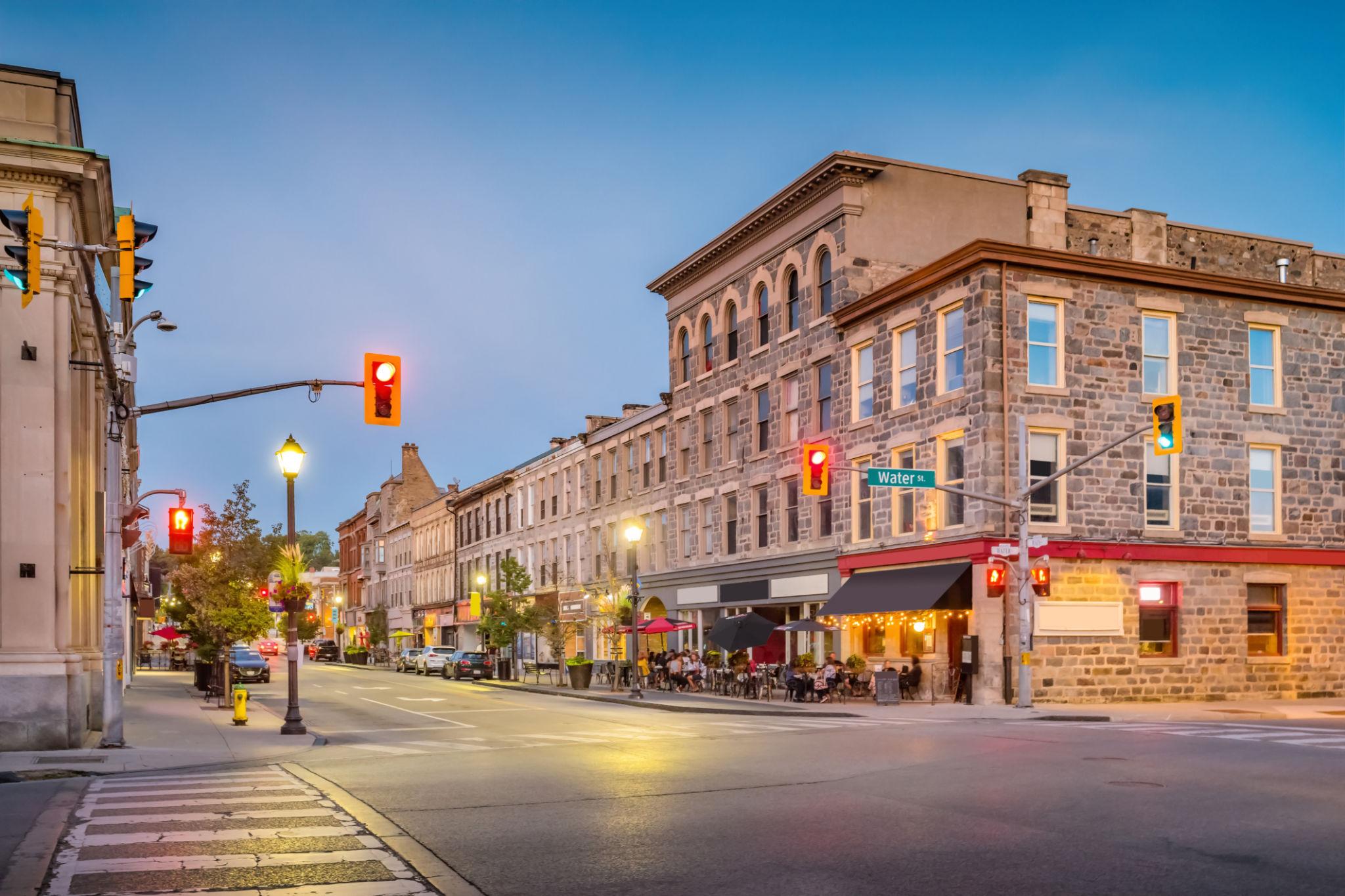
A two‑storey brick commercial building in downtown Galt with long street frontage and rear lane access has 60 percent main‑floor retail and 40 percent upper floor creative office. The retail rents are reasonable, but the office component has above‑average vacancy and higher tenant improvement costs. A straight cap on stabilized NOI might point to 2.2 million dollars using a 7.5 to 8 percent cap rate. Sales comps are scant and idiosyncratic, some with buyer‑users. A cost approach, even with careful depreciation for functional issues, sits above the income number. In reconciliation, the income result carries more weight because buyers of this type of asset are underwriting the leasing risk and the near‑term capex, and they need yield to compensate.
A 50,000 square foot owner‑occupied industrial facility near Laird Road, 24 foot clear with two docks and two drive‑ins, on 3 acres, is clean and well maintained. There is no rent roll. Sales of large, older owner‑occupied industrial buildings regionally show a broad band, say 120 to 220 dollars per square foot, with Cambridge tending toward the higher part of that range due to 401 access. A cost approach shows replacement cost new of roughly 11 to 13 million dollars when you include hard, soft, and entrepreneurial profit, but functional differences, site layout, and the cost of land today versus when the owner bought it compress that. In reconciliation, the sales comparison and cost approach together tell you where a buyer‑user would likely land, with income used only as a hypothetical cross‑check at market rent.
How to work with your appraiser for a better outcome
You can improve both speed and quality by sharing a focused set of documents and answers at the start:
- Current rent roll with lease abstracts, including options, inducements, and any side letters.
- Last two years of operating statements broken into recoverable and non‑recoverable expenses, plus capital expenditures.
- Any recent capital projects, with invoices if available, and a list of near‑term needs that your property manager is tracking.
- Survey, site plan, and any planning approvals, plus environmental reports and building condition assessments.
- If you recently bid construction or tenant improvements, share those numbers. They are invaluable for the cost approach and for modeling leasing costs.
This is the point where hiring local helps. Commercial real estate appraisers in Cambridge, Ontario know who is leasing, who is renewing, and which properties have hair. They also know when a national headline trend does not apply to a local block.
Final thought for decision‑makers
The cost, income, and sales approaches are not rival theories. They are three angles on the same question, each more or less useful depending on what drives the property’s value. In Cambridge’s mixed market of corridor retail, river‑adjacent heritage stock, and hardworking industrial, the best appraisals treat the methods as tools, not checkboxes. If a report reads like it could have been written for any city, push for more Cambridge in the analysis. That is where the real value lies.